THE NEIL COLGAN TRAGIC STORY and a bit of background … Having moved from my seasonal GS-PRC-8 Warden job in Yoho N.P. to my permanent full time position as a GT-2 in Banff N.P. in April of 1975, my fellow buddy wardens, Scott Ward & Randy Chisholm, informed me that now I was the youngest warden on the “totem pole”. Initially, I lived up the Spray River Fire road, at the Spray 8 Mile Warden house (since demolished) and commuted daily to report to the Warden Office in Banff. In those days, we were alternating shifts between the frontcountry (10 days on & 4 off) and the backcountry (9 days on and 5 off). My backcountry area, patrolling with horses, was north up the Cascade Valley, including the Stoney Creek, Dormer, Barrier and Windy cabin areas and drainages. In those days, while the road was closed to public vehicular traffic, we were able to use our stock truck, usually dropped off and picked up by our barn boss, Jim Burles. I eventually was transferred over to the Lake Louise area in October of 1975. My backcountry area responsibility then became the Pipestone River (Little Pipestone & Pipestone Pass Cabins), the Red Deer River (Cyclone, Sandhills, Scotch, Divide Pass, Indianhead and Clearwater Cabins) under the direct supervision of Dale Loewen. So, this leads up to the story with Neil Colgan, which I had met while he was working in the Banff area on various training schools & courses. Neil was relatively new with the handling of horses, but was provided mentorship and training prior to setting him off on his own. At the time, both the Lake Louise and Banff area wardens shared the Scotch Camp cabin. Neil had ridden from Scotch Camp westerly along the Red Deer River to the next line cabin at Sandhills. It was from there that he was on a day ride to Douglas Lake, travelling with a saddle horse and one pack horse, he left one in the corral at Sandhills, which was the normal routine. As the story of the backcountry radio call goes, we had the Single Side Band (SSB) radio system for communicating from between Banff HQ and within the cabins. Although the quality was subject to weather conditions from time to time, Sun spots, solar flares, etc. as the signal bounces off the ionosphere, it was operational at the time. For our safety, a twice daily (mornings and evenings) schedule was maintained with a cabin “roll call” initiated from the Banff HQ. With all cabin users tuned to that particular frequency, we could hear each other. After “roll call”, the backcountry staff could chat between each other and discuss whatever topics they wanted, usually events of the day … As the story goes, Neil missed the evening radio call on July 25th (1979), as well as the morning and evening checks on July 26th, so it was like the “strike three protocol” and someone was going to come looking for you scenario. As I recall it, and from my personal notebook diary, Bill Vroom, a Senior Warden out of the Banff HQ area, had ridden in by horse from Scotch Camp to the Sandhills Cabin. He radioed me from Sandhills at 8:30 PM advising me that there was no sign of Neil, but both of his horses were there. Bill then asked me to saddle up a horse and to ride from Cyclone Cabin over to Douglas Lake that evening, where Neil had planned to day ride. So at 9 PM. I was on the trail with my saddle horse, named Cactus, the calmer, quieter mare of my string, rather than my other horse, Kiowa, a much younger and “spunikier” gelding. As I knew that this was going to be a ride in the dark, in the those days, we didn’t carry the now-a-days compact headlamps for night time events, I had chosen the mare for being more reliable under those conditions. I arrived at Douglas Lake around 10:15 PM, noticing horse hoof prints on the regular trail, parallelling the west side of the lake; they were north bound and likely headed towards Sandhills Cabin. Jim Davies (pilot) arrived in a 206 helicopter around 10:20 PM and managed a visual contact with me while hovering along the lake shore, in the growing darkness (as in those days, we did not have portable VHF radios to communicate with in the backcountry).It was at that point I decided to return back to the Cyclone Cabin, as there wasn’t much more that I could do or see. Due to the failing light, the helicopter then returned to Banff HQ for the night. It was one of those totally pitch black nights, under dark and cloudy conditions, where you could barely see your own hand in front of your face. I remember my good old Cactus mare carefully and sure-footedly, slowly heading our way back to the Cyclone Cabin, arriving at 1 AM in the morning, now the next day, July 27th. Considering the situation at hand, I was back up and on the SSB at 6 AM that morning (July 27th), chatting with Bill Vroom at Sandhills and Moe Vroom (Warden Dispatch supervisor and secretary to the CPW) at the Banff HQ for the update. It was then that I learned that a bridle was found near the Sandhills Cabin, while the saddle blankets were on the trail near Douglas Lake. At 8:15 AM, a Banff warden search dog had located Neil’s body along the shoreline. I recall later that morning as I watched a helicopter sling his body out and past Skoki Mountain towards the Lake Louise area. It was indeed a very sad day for me and a reminder of how a situation can go bad very quickly when in the remote wilderness. But it is also a place, for those that chose it, where an individual can truly appreciate the solitude and tranquility of that special place in the backcountry …


Employment history with National Parks (35 + years):
- Yoho National Park, June, 1973 to April, 1975
- Banff National Park, April, 1975 to October, 1979
- Jasper National Park, October, 1979 to June, 1987
- Northern Yukon (Ivvavik), June, 1987 to October, 1989
- Wood Buffalo National Park (Fort Chipewyan), October
- Elk Island National Park, August, 1994 to August, 1998
- Jasper National Park, August, 1998 to July, 2008 (Retirement)
A few accomplishments along the way (in no particular order, so random, time wise):
- Avalanche control (ski areas and highway); Sunshine, Lake Louise & Marmot Basin.
- Hands on management with the Fisheries programs (spawning, stocking, creel census, etc.)
- Porcupine Caribou herd monitoring in the Yukon and Alaska.
- Polar bear, Beluga whale, Bowhead Whale monitoring in the Beaufort Sea areas.
- Muskoxen observations, finally confirmed calves being born in the Yukon vs. Alaska
- Use of watercraft: jet boats, airgators, outboards, etc. Lake Athabasca and river.
- Experiencing the vastness of WBNP, larger than the country of Switzerland.
- First permanent warden residing in Inuvik, administering the Inuvialuit Final Agreement (IFA) for Northern Yukon N.P. (Ivvavik).
- Backcountry patrols, horses, skis, snowshoes, hiking, boat craft (jet & outboard), aircraft (fixed & rotary), air boat etc.
- Working with Indigenous Peoples: Inuvialuit, Cree, Loucheux, Chipewyan, Metis.
- Employment Boards, competitions for future Warden recruits & others.
- Luigi Morgantini Elk Study, Ya Ha Tinda Ranch & Red Deer River area.
- Multi-agency cooperative exercises: Alaska, Yukon, Police forces, Provincial Fish & Wildlife Agencies, etc.
- Therapeutic Horseback Riding & volunteer programs, Jasper National Park.
- Aquatic Resources Management (Fisheries): Banff, Jasper & Ivvavik.
Warden Service Changes over the time:
Of which there were many. In the early 1970’s, Park management realized that they had to change from simply maintaining national parks as static environmental entities, with staff that could either be present in the front country managing campgrounds, providing recreational opportunities, especially fishing through an active stocking program, for example. The backcountry personnel, wardens, were hired for their basic survival skills, handling a horse in the summer and eventually transitioning up to dog sleds, snowshoes and XC skis in the winter, but lacked in the scientific and academic sense about the flora & fauna knowledge. So the move was on to hiring new recruits (Sime-Schuler Report) that were initially trained in 2 year technology programs (forestry, wildlife & environmental) that later morphed into 4 year university degrees and eventually to PHD’s and Master’s. Along that career path, the recruitment and developmental skills still included all of the outdoor recreational activity disciplines or practical skills such as in Public Safety (climbing/skiing), Backcountry (horsemanship), Law Enforcement, etc.
● (0:33) Yep, that’s correct! I did two tours of duty in Jasper. Over 18 and a half years of my career were spent there. (In response to the comment, “You’ve answered the first few questions, I have
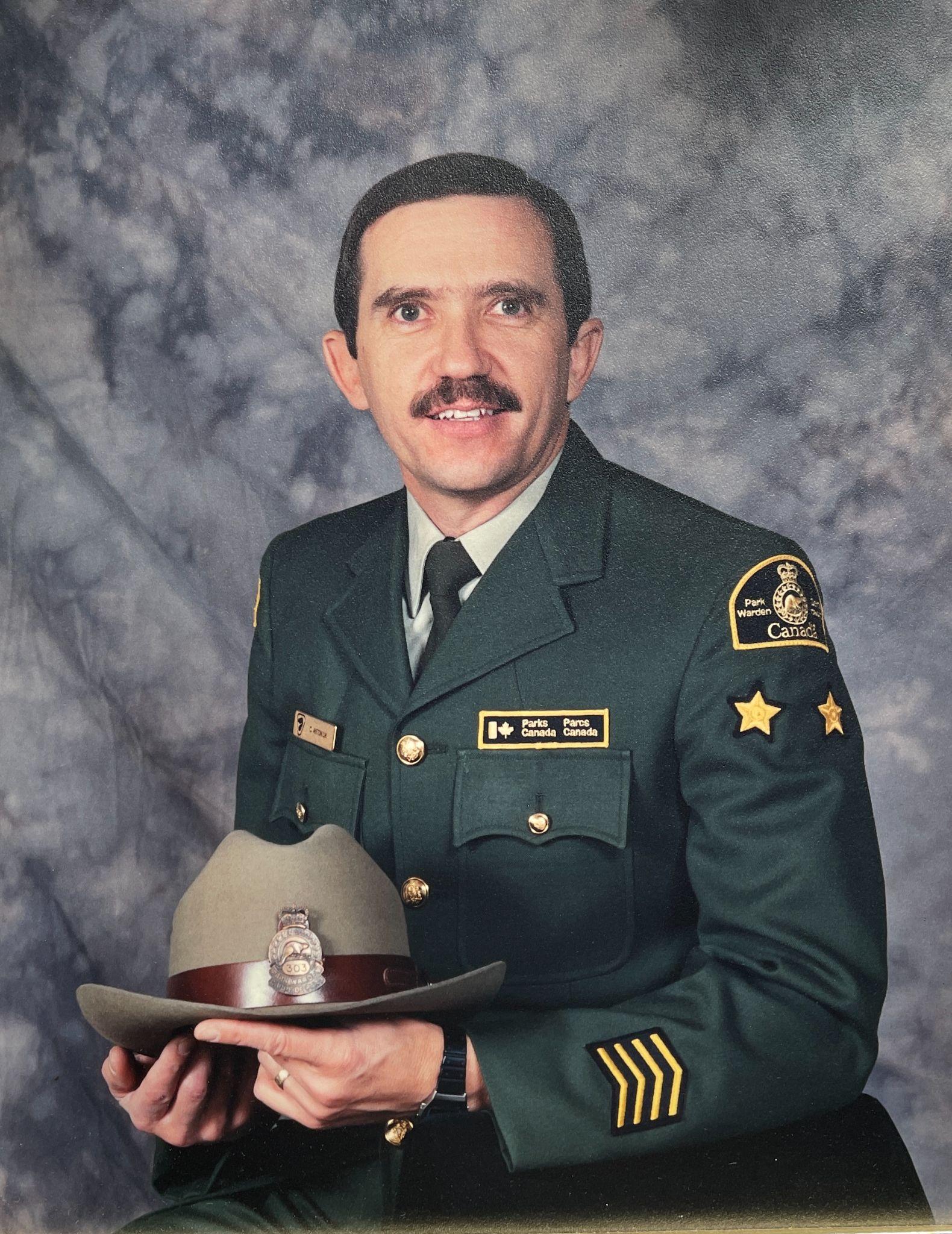


about your place and date of birth, where you grew up and how you became involved in the
service. And you talked about the different parks you worked in – Yoho (1973-1975), Banff (1975-1979), Jasper (1979-1987), Northern Yukon (Ivvavik) (1987-1989), Wood Buffalo (1989-1994), Elk Island (1994-1998) and Jasper again where you finished your career (2008). (1998-2008). I was born and raised on a farm and I left it at the age of 18, so in essence that is why Jasper (total of 18+ years of service) is my favorite, as far as a place to live. When I go back there (Jasper), it is also quite comfortable, like I did two weeks ago for the Warden Alumni Days. To walk the streets and see long term resident folks in Jasper that I know. And I still like going back to hike and see the backcountry, of which I am familiar with.
(1:23) I know that’s a question that I get asked regularly by people when they find out where I worked. (In response to the comment, “So that was my next question…Jasper was one of your favorite parks?”) I end up saying they are all unique. Every park has its own reason for why it was established. While I may say I have favorite things within each one, they really are so unique that you really can’t say, ‘Well, I like one better over the other.” A primary reason I go back to Jasper is because of longevity – having spent 18 and a half years there. It was probably the best of my long term career.
(2:16) Well, boy everything…(In response to the question, “What were some of your main responsibilities, you talked about law enforcement and wildlife?”) We were always generalists in those earlier days, in the early 1970s. Generally speaking what happens in a career path is you start out as generalists and work in all the disciplines and fields. You get the experience and then as time wears on, you end up gravitating upwards because of more responsibilities, education, training and so forth. So I advanced from being a seasonal warden in Yoho right up to Operations Manager in Jasper, at the end. Along the way I did act as Chief Park Warden in many of the parks. And you may note near the end (of my write up) how I said I was kind of on the fence because I was in middle management. Meaning I would be acting in senior management positions and then I would fall back to my old position and back into the field. It was sort of a juggling act … I had a good understanding of the field operations, with the opportunity to influence management as to why there were pros and cons was challenging at times.
(3:36) What were your responsibilities: As for public safety…I was born and raised on the farm in the prairies, so my desire to climb mountains and icefalls and so forth was not very great! But I always maintained my public safety training to the intermediate status … and then there was skiing. I had never skied upon entry into the Warden service until I attended a training school in Banff. We went up to Sunshine Ski area in November, 1973, with Peter Fuhrmann, Alpine Specialist, and a group of what must have been 20 of us, all greenhorns! Well most of us were greenhorns! Peter…quickly realized there were some of us that were not experienced (at all) so he went and hired the Sunshine Ski School to put on a course for a handful of us novices. That was the beginning of my career in skiing. Well, in March of the following year, 1974, I was on the Wapta Traverse! From Bow Hut to Balfor to the Daly Glacier to come out at Sherbrooke Lake. Back in those days, everybody was a group. We worked together and helped each other and there were lots of opportunities to learn. But what a broad experience, in white out conditions, to I think it was minus 40 degrees Celsius that one morning on the Daly glacier when we woke up. That’s the type of things in those days we did. Horsemanship too, was the same thing back then. Initially there wasn’t a whole bunch of tutoring or training, you were sort of thrown the gear and (told) to get on and then away you’d go.
(5:17) More on Responsibilities: I was doing law enforcement on the Trans Canada Highway in Yoho and back in the 1970s there were lots of…I wouldn’t say they were hippies, but there were lots of transients going through.They were hitchhikers and sometimes weren’t able to catch a ride, so sometimes they would have a little fire along the side of the highway. And here we were out there literally not with any technology and radio communications to a Dispatcher. We were out there doing things, on our own. Talk about verbal judo in those days, it was sink or swim! You had to talk your way in and out of things, but we survived! I mean it was not the way to do it, but eventually we turned things around. Now we have more formal training and recognition, it is more of an awareness of the Canada Labour code, making sure that they are providing the tools for people to be safe at their work.
(6:09) But back to work responsibilities again, everything from resource management where I looked after the Aquatic Resources (Fisheries) program in Banff initially, and then in Jasper. And even up in Northern Yukon, I worked with DFO (Department of Fisheries and Oceans) doing research on the Arctic Char and Grayling…I guess in Jasper too with the stocking program and then working with the limnologists and biologists…the limnology work was a good experience. I still, to this day, know a lot about the Jasper lakes and what was stocked and what’s surviving (naturally reproducing) and so forth, from my hands-on experience with the limnologists from our Calgary regional office. Joe Kilistoff was definitely my aquatics resources mentor, for instance.
(6:55) And then projects such as the Porcupine Caribou herd monitoring. Having been the first person, first warden I should say who actually lived permanently in Inuvik…Ray Frey was my initial Chief Park Warden, but he lived in Haines Junction and he just came up periodically during the summers, before he transferred to Riding Mountain N.P. So initially, I was the first guy to permanently live there (Inuvik) and open the office in the DPW building and get things established. Shortly after, Bill Dolan arrived in the Chief Park Warden position (fall of 1987). Following that, we hired Linda Binder as our office Admin Assistant (IFA beneficiary), so we were a 3 person office. Linda eventually became the Field Unit Superintendent. It was located on the second floor of the DPW building, above the Post Office & on the corner of the only intersection with traffic lights. Part of my involvement was as part of the team with the Yukon Territorial government, the Alaska Fish, Wildlife and Game agencies.That included monitoring of the Porcupine Caribou herd, a huge


migrating population between the two countries. I was able to accompany the biologists that were in charge of conducting population counts, via aerial photography surveys. We are talking about 150 thousand animals! It was also interesting to observe that Muskox were confirmed to be born in Canada (Yukon) versus only on the Alaskan side, as previously thought. There wasn’t much prior resource management monitoring going on. But we, Parks, were there now in Inuvik 12 months of the year, so we would fly up from Inuvik to the Park in Northern Yukon periodically. As you are probably aware it is above the Arctic Circle. So from about December 6th to January 6th, the sun does not come above the horizon for that one month and then you’d still have a “legal flying time” of about six hours for single engine aircraft (fixed wing and rotary). But we would still try and make it up there to see what was happening, noting all elements of the environment, such as wildlife, etc. There was evidence of resource poaching going on from residents from the Alaskan side: grizzly bears, arctic char, wolves, and caribou, you name it. Our presence on the land definitely made a difference and we were able to turn that activity around. So that again was the law enforcement aspect of the job. If I remember correctly, the Lacey Act (USA) was used to successfully convict an Alaskan dentist, who owned and operated a Super Cub fixed wing aircraft (short take off & landing capability) to fly in and poach.
(8:39) From Inuvik I transferred to Wood Buffalo N.P. (1989) and lived in Fort Chipewyan, Area Two district, as the Area Manager, by replacing Ron Davies. In reality, I was the assistant or “de facto” Superintendent because of the remoteness from Fort Smith. So liaison with the local indigenous people, the Cree Band and the Cree Land Claim settlement implementation was part of my responsibilities. It was interesting working with the Cree, the Chipewyan & Metis communities.Then I relocated to Elk Island (1994) where I coordinated the law enforcement program and participated in the resource management programs. Lots of active resource management, along with other warden staff, to do with the Elk, Plains and Wood Bison roundups and transfers, with little involvement in the Trumpeter Swan reintroduction.