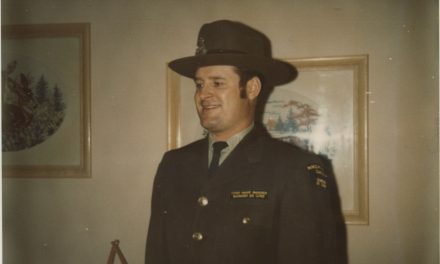
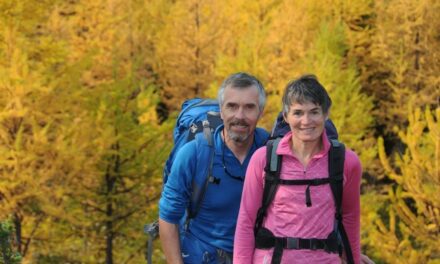
(9:28) Then back to Jasper N.P. (1998) as the Backcountry Manager and eventually through organizational changes, I became both the front and backcountry Operations Manager, through to my retirement. Anyways that would sort of give you a smattering …


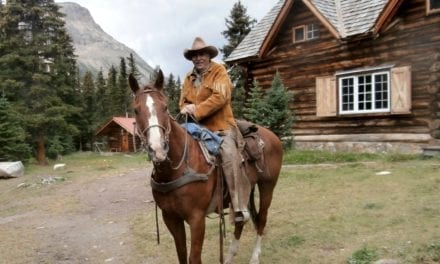
(9:59) Well, that’s a good one! (In response to the question, “What did you like best about being a warden?”) I guess the best was, I have to say the backcountry, for sure! To this day, I will comment that I miss the horsemanship program and the work with the horses, the staff, the wildlife, and the remoteness. I mean there are things that can happen. But you have to, in the backcountry when you are all by yourself, you have to be self reliant. That’s why, to this very day, I don’t mind hiking by myself because I am more vigilant and aware of what is going on around me, rather than being distracted sometimes with other folks along the way. But backcountry activities and horsemanship were definitely the best experience and the love that I had for the job…I was also on a few recruitment staffing boards, as I advanced into senior positions, for competitions for hiring staff…sometimes they were multi park competitions that created eligibility lists. But seeing the satisfaction of a person come up through the system and you mentor and help them was very rewarding. In particular, one individual who wanted to go on a CUSO (Canadian University Service Overseas) assignment. That meant he would have had to leave his numbered seasonal position for the two years assignment. I managed to lobby for him and get that management support so if he wanted to come back after the two years he would be allowed to rejoin Parks Canada and which he was able to do. I figured it would be good program managerial experience that would certainly help him in his career path down the road. It was things like that, to see people whom you mentored and helped along and supported and who did well. There was satisfaction certainly in seeing that, it was all about teamwork and cohesiveness. Working with people to see them to their best within their careers, recognizing their abilities and seeing them to the point of achieving success was important to me.
(12:48) I didn’t, that’s the interesting thing! (In response to the question, “Going back to the horsemanship, growing up on the farm, did you have lots of experience with horses?”) We had a mixed farm, no horses at all. In fact, I remember when I went to the interview board with Bud Armstrong and George Balding (1973), I asked about talking to some horse outfitters to get some horsemanship training and they said, “No, we prefer you actually didn’t at this point. Because if and when you are successful and you do come to us, we will teach you all of our horsemanship habits and then we won’t have to break any bad habits!” But having worked with farm animals, we had cattle, pigs, chickens, which helped and I did raise heifers and steers for the Tofield 4H club and Registered Horned Herefords for farm fairs for competitions, showing and breeding stock. So I had lots of hands-on farm animal experience, including with pets (dogs & cats).
(14:13) Initially Art Cochrane…and Don Mickle. (In response to the question, “Who (in the warden service) did you learn the horsemanship from?”) Art Cochrane was in Yoho at the time. I remember him taking me to the Ice River via the Leanchoil Warden Station. It was just a day ride, on a horse named Charcoal. Charcoal was one of the horses who was pretty spunky! They used to use him in those warden gymkhanas at Hillsdale Meadows in Banff. Of course, Art was a very experienced horseman from I think his previous experience as an outfitter’s son. That was a learning moment, when he taught me how to get on properly because I did get bucked off very early that morning! I remember Art saying “you get on like a sack of potatoes and you get off like a sack of potatoes”. Anyways Don also helped me and I would help him from time to time, of course living at the Ranch cabin made it easier. He was on trail crew, moving supplies up and down to trail crew camps, like on the back side of Mount Burgess, along Emerald Lake, Ice River places like that, the Ottertail and the Good Sirs. So he helped me immensely as well. But I guess, between the two of them, that’s probably…the start of the horsemanship. Then of course moving from a seasonal position in Yoho to Banff, then that was with Jim Burles, the “Barn Boss”. But Jim was more of the guy who was into trucking, shoeing, assigning horses and tack. I would also say thanks to Dale Loewen, Lake Louise Warden supervisor, as he was who I worked with there. Well, I’ve got to go back to Jack Wilman too…when I was still in Banff, I was in Banff for the summer (1975) and we did patrols up Stoney Creek, Dormer and Barrier, and so forth. Jack Wilman is a very knowledgeable horseman and he taught me a lot of skills.Then following that I made a trip with Earl Skjonsberg, with his search dog, Ruff, was another one. Earl and I made trips in that same backcountry district.


(15:54) This is another story to do with his (Earl’s) dog, Ruff. Usually we worked shifts of nine days on and then had five days off, in the summer. Ruff was his search dog for the Banff warden service. So we were up at the Barrier cabin on the Panther near where they’ve got the bison reintroduction now. There was a thunderstorm brewing with lots of thunder and lightning. We left the cabin door open, as we were having supper, so Ruff could come and go. All of a sudden near dark or getting ready for bed we just recognized that Ruff was gone! We looked around and called for him and of course he was not to be seen. We had the backcountry radio schedules, with the Single Side Band (SSB) communications back to Banff headquarters and we let them know that Ruff was missing. Earl had a sense that he didn’t like thunderstorms, lightning and thunder and so forth. It turns out he did make it all the way back to Banff after a couple of days. But what I recall was that was basically Earl’s last sort of backcountry shift because he had to make the decision and I think management was with him to (decide) either, “You’re going to be a dog master or you are going to be in the backcountry.” Because when you are in the backcountry, you don’t have easy access for search and rescue operations or whatever purpose the dog was going to be used for. So that was kind of a changed venue for Earl in that case at that time, he was great to travel with, so easy going kinda fellow.
(17:10) Then I moved to Lake Louise, later in the fall of 1975…and worked in the backcountry with Dale Loewen, where Jack Woledge was the dogmaster. The horse experience continued after that.Then in Jasper, formal training with Denny Welsh, Jim Chesser and of course going to the Ya Ha Tinda Ranch, taking Advanced Horsemanship courses with Slim Hogan, Johnny Nylund, Rick Smith, Dick Levie and others at the Ranch. It was just on and on because as you know, Christine, this isn’t sort of a one shot deal. After 35 and a half years you pick up stuff and you always keep training because there always seems to be new horsemanship training techniques being deployed all the time. So when those younger horses (colts 3 and 4 year olds), and that was the other thing, most senior horse people in each of the parks would get the younger horses to mentor them and bring them into the Park stock for each of the parks. So you had to know the techniques that the colts had been trained with because it was important for your satisfaction and the horse’s benefit, and ultimately the park and the public and all that stuff. It was important. And that was very rewarding to pass on those new techniques of horsemanship… instead of the heavy handed stuff that was happening in the 1970s… Now, it’s soft hands and it’s just turned right around. But it’s very rewarding to see and bond with the horse (my assigned horse, Levi, in particular).