(18:46) Oh yes…(In response to the question, “Is there anything you didn’t like about being a warden?”) I guess “staff relations” issues were always the part that most supervisors don’t like to do, but you had to. You know, you had to apply the “code of discipline”, if and when warranted, with staff…from a human resource management aspect. But leaving the human element side of it (being the tough guy, at times), I don’t think there was too much that I didn’t like.
I mean look at all the parks I moved around to! It was quite a change in venue, like in northern Yukon…Inuvik was selected as the place to house park staff because the park is literally an hour and a half away by a 206 helicopter, for instance. It’s remote! You have to fly in either by a fixed wing like on a Twin Otter or an Islander aircraft and then there were the DEW line sites (Distant Early Warning), two of them in the park at that time, Stokes Point and Komakuk Beach.
(19:52) And then from a recreational activity aspect, the greatest number of Park visitors was rafting down the Firth River. So we had to learn how to white water raft and I’d never rafted down a river with class 4 rapids. So we did training with a company that came in and trained us. So what I’m saying is that depending on where you worked you had different tools in which to carry out your patrols. The North was certainly aircraft oriented patrols. Wood Buffalo NP was similar, with the huge Athabasca Delta, Mamawi Lake and Lake Claire…we employed indigenous locals as patrol people. They were born and raised on that land so they knew the “ins and outs”, like the back of their hands, they were like “taxi drivers”. Jet boats weren’t conducive for travel into the interior of the park, but were used on the main Athabasca River & Quatre Fourches River, then along the Peace River to Hay Camp. So depending on which geographic location you were in, you ended up using whatever tools (boats, air boats, rafts, snow machines (bombardiers) & other aircrafts) that were appropriate to patrol and monitor the natural resources with.

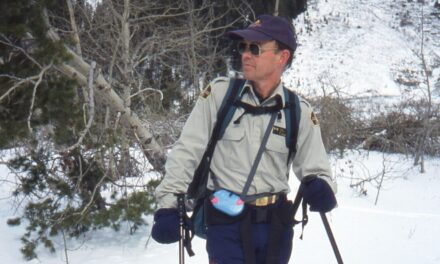
(21:06) Then back to the mountain block where travel was via horses and/or hiking on the trails. Horsemanship skills were very valuable in patrolling the north and south boundaries in Jasper. Back in the old days you used to work 21 days straight and then it dropped to 17 & 4 days off. I mean the north and the south boundary trail systems are each 100 miles long, without doing side trips up side valleys. So there is no way you could do that creditably & meaningfully, in a shorter time frame.
(21:50) Well, there are…if I could think about that a little more, what I will do is write down some more of these stories… (In response to the question, “My next question is about some of your more memorable events (of your warden career). You wrote about Neil Colgan…are there other stories that you would like to add?”) Well, even the whitewater rafting on the Firth River, that could be pretty dangerous…and working with Herschel Island staff, which is a Yukon Territorial Park, and the Rangers there was a good relationship. That was a good story to do with cooperation and working together from different jurisdictions. Other memories to do with law enforcement situations involving some Americans (from Alaska) and poaching stories (Northern Yukon). There were other situations, such as along the Yellowhead Highway 16 in Jasper, the Trans Canada in Banff/Lake Louise & Elk Island NP parkway, with regard to enforcement situations that I got into were very lucky for me that I got out safely, but not for the accused, with several successfully prosecuted cases.
(23:49) Fisheries was another interesting component, in Jasper, in particular. I did Lake Creel Census studies there with staff, but also getting back to Joe Kilistoff and the Limnology program. I was selected both in Banff and in Jasper, where I participated in Cutthroat fish egg spawning collections. Cutthroat are the native trout species to this Bow River system and Rainbows are the natives up in the Athabasca system. I was able to accompany provincial biologists and fisheries technicians into Marvel Lake in Banff National Park where we collected cutthroat spawned eggs, where everything had to be timed correctly. Access was by helicopter, we were there for three or four days, camped beside the lake.The eggs would be fertilized just prior to the chopper coming. It was usually Jim Davies coming in and flying them to Banff and then they were trucked into the Sam Livingston provincial hatchery in Calgary where the fingerlings were raised.Then we’d eventually get the little fingerlings to stock in the Park lakes. The same thing, we continued to do this in the Province (Alberta) up in Wilson Lake, also known as Job Lake or Blue Lake. I went in there on a couple of occasions and spawned Cutthroat eggs again with the provincial fisheries technicians. We had to have the eggs fertilized just prior to the helicopter arrival, everything was about timing, weather wise and communications and to get them into the Sam Livingston Hatchery in Calgary was critical for survival and success. So that was nice to see the front end field work and then you’d get the fingerlings back the following year and you’d stock them in Park lakes. It was quite an active program. A “put and take” fishery, we called it because of the active angling, national parks of course had angling (the only consumption of natural resources permitted) … I’m getting back in history, but after World War II, Park management thought: “How can we attract visitors and Canadians to visit national parks?” Well, “Let’s open up fish hatcheries,


in Waterton, Banff and Jasper.” Jasper was the biggest and the last one (active) before it was shut down due to the Infectious Pancreatic Necrosis (IPN) fish disease. It even produced exotic fish, like Quebec Reds, Atlantic Salmon & others, such as Splake, which was developed by Ernie Stenton. For instance, to this day, we still have introduced Lake Trout in Jasper, in Moab Lake, where Parks also introduced Cisco (or Lake Herring), a species that they (Lake Trout) would normally feed on in the Great Lakes. It’s a little white fish type … anyways we have all those stocking records & a history manuscript, thanks to J.C. Ward, Canadian Wildlife Service Limnologist (Scott Ward’s father)…prior to my involvement they (Parks) would go in and actually poison (Rotenone) out a lake to get rid of any undesirable fish, such as suckers or lake chub or anything else for that matter, so that they could bring in the more desirable sport fish (i.e. Rainbow or Eastern Brook Trout) and that would attract more people to enjoy national parks and appreciate them and all that kind of stuff. Well, that got to the point where there was the expectation to have a high level of a sport fishing type of experience and so we needed to stock fingerlings, or so that was the policy of the day. I was very hands-on involved in the Jasper program, where I worked with the Canadian Wildlife Service biologist, Dave Donald, who published studies. Prior to stocking the fingerlings, on occasion, I supervised a community volunteer “fin clipping” operation up near Cabin Lake. By this method, we could visually determine their age right out in the field.There are five fins that you can clip on a fish so that you would know their age without having to kill them. With captured fish, one can also determine age by analyzing their the otoliths (a little bone or ear stone) in the inner ear…But visually through a creel census, you could see which fin was clipped and you would know exactly what year that was stocked and you’d know exactly how old that fish was. So our stocking density for each lake, depending on productivity, was approximately a half to a three quarters of a pound of growth in one year, which is about the right size for a “pan sized” fishery target, for people to enjoy sport fishing. So I would hike into stocked lakes and conduct test nettings with gill nets, weigh the captured fish & have an idea if we were on target or not. Then we would adjust our stocking density targets accordingly, as to the number of fish per hectare area of the lake. In Jasper, in particular…the nets would only be set overnight because depending on the temperature of the lake water and depth that they were caught at, the flesh might not be edible.The fish that were still firm and edible, would be dressed up and turned over to the Senior’s Lodge, in Jasper, for their consumption. That was one way of working with the community and appreciating their help, as I had community volunteers assisting in both fin clipping and test netting operations.