(59:41) Well, Hal Sheperd, I will say, was my inspiration. (In response to the question, “You mentioned some names like Hal Shepherd and Jim Sime. Is there anyone from the warden service or others that stand out in your mind? I know there are and were some real characters (in the warden service)!” Hal was my first Chief Park Warden in Yoho National Park (1973). Aside from some of his antics, I mean he was a colorful character! I believe he was the first one eyed private licensed pilot in Canada. He was a war veteran, had been captured and survived from not pleasant treatment. But he had some insight and he took me under his wings at times…I will use the example of the annual performance evaluations. It was more or less a contract between the employee and the supervisor, with set goals or objectives including timelines and product deadlines. So you would sit down at the beginning of the year and they’d say “These are your goals and what you need to do on a yearly basis.” It would include training and development and

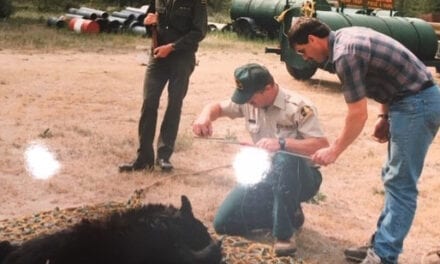
so forth and responsibilities whether it was for resource management or public safety or whatever discipline. But Hal was the first supervisor I had that would bring me in on an appointment basis. He would give you your evaluation, we’d discuss it and he would say what you did well and what could be improved. Then he said, “The door is closed.” And this is really tough to do, as a junior employee to the organization, especially coming from someone with his depth, experience and history. He would say to me, “Okay now, tell me how I am doing as a Chief Park Warden?” And he was sincere about it. I saw Hal and Norma, his wife, on a very personal basis during my two years in Field (Yoho). He was sincere and we talked about it…I mean he had a personal trust and believed in me. He had some issues and I won’t deny that, but there was an occasion, in my junior years, when I had an experience with a black bear along the road to Emerald Lake. He took me to the side, not in front of anybody else, and he said, “This is what you should have done.” He said, “Next time this happens, this is what you should try.” That just set the stage for me to recognize that you don’t have to put somebody down in front of your peers or the public. You can do it effectively behind the scenes and that was Hal Shepherd…that was in 1973. So you can go back to how many years ago he set the stage for me to where I am to this day. It’s just one of the goals or principles or however you want to say it, that set me on the course to say, “I learned from that and I am going to use that for others.”
(1:02:35) So, other people…boy I don’t know where to begin, but there are just so many along the way, in each of the national parks that I worked in. I mean the Indigenous people in Fort Chipewyan for instance, brothers Johnny and Willy Couterielle, known for their hunter and trapper knowledge. Unfortunately Willy has passed away now. Anyway, they were hired on as Park Patrolmen, born and raised Indigenous people of the Cree Traditional Land that helped me learn from their existence on the land. Wood Buffalo National Park is the largest in Canada and second largest in the world after, I think, the Serengeti, but anyways larger than the country of Switzerland, it is huge.To conduct a fixed wing fire smoke patrol takes you almost half a day, compared to some of these smaller parks where you can be in and out very quickly. But they taught me a lot about the land and how they survived. We would go out in a patrol boat into the park and observe Bison swimming across the creek near the infamous Sweet Grass Landing.They would pick up fresh fish from their gill nets in the river near Doghead and we would fry them up on an open fire near one of our patrol cabins. By the way, Wood Buffalo is a UNESCO World Heritage Designation Site. To see the Blue Heron nesting colonies along the Birch River or other rare things like the nesting colonies on Gull Island. Due to the park’s size, it certainly has a plethora of natural wildlife species, such as the Red-sided Garter Snake hibernacula, the Whooping Crane colonies, karst formations composed of gypsum, limestone and dolomite for example. There were just so many unique things that they could show, share and teach one about, but in a subtle way, in an Indigenous way. Gentle hands…it’s something that you can only grasp by being there in person with them on the land. Observing whatever, might be a beaver collecting its twigs on the river and splashing its tail as we got too close…so that was from an Indigenous perspective, an experience that you just can’t take for granted. While it might seem childish in a way, they would pull pranks on each other and laugh about it, as well as some of our office admin staff that were harmless jokes, yet heart warming.
(1:04:33) Every park had somebody or something…it was a team. Everybody worked together and you saw strengths and weaknesses and you helped each other and developed in the areas that you needed to…
(1:05:22) Well, my favorite Park horse was actually my last horse. (In response to the question, “Any lasting memories as a warden? A favorite cabin or horse, or place?”) Levi was his name. He was a chestnut gelding and I had him in Jasper. He was a horse that was spunkier, he had some issues, let’s just say. He was born, raised and trained at the Ya Ha Tinda Ranch. He came to Jasper and the Barn Boss up there is Jim Chesser. Jim of course looks after all the horses

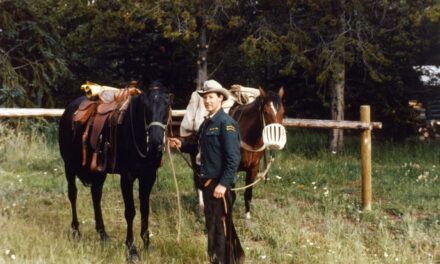
but he can only spend so much time on some of the younger ones, the “issue horses” that need some help. So I was allowed to take over Levi. Jim and I were the only two that eventually would ride him because of his certain temperament. Jim used to say, (riding Levi) “Was like a roulette wheel” You know the ball is spinning on the roulette wheel, but all of a sudden when it pops out, look out! But he never hurt me, never bucked me off. He and I, over four or five years we just melded. He was my assigned Park horse and when we would go into the backcountry, at night, the horses would be hobbled, as in Jasper we don’t have the benefit of many pasture fences. We have some good fences, but not like in the smaller parks like Banff. But when we were out in these remote areas with half a dozen horses hobbled and some with a bell around their neck, to find them, generally speaking, others (who ever I was travelling with) would try and go over to him and throw the halter on and take the hobbles off and he would not respond well until I was there. I dearly enjoyed and loved that animal…he is in the book of the Ya Ha Tinda ranch if you look through it.

In the picture we were improvising how you would skid a log for firewood, or for corduroy, or for building a bridge or something …he’s not liking this rope dragging the piece of log behind us! I was able to go through some advanced horsemanship training with him. And chasing elk … this is one of the things we did at the Ya Ha Tinda Ranch. As the resident elk herd seemed to have lost the knowledge to seasonally migrate out of the grasslands around the Ya Ha Tinda Ranch to the west, like they used to, during the elk study that Luigi Morgantini did in the mid 1970s there…so the Ya Ha Tinda ranch staff would bring a whole bunch of us down on horsemanship training and then we would all, say 12 of us? I can’t remember the exact number of people, but we’d gather up around this herd of elk and try to push them physically west, to the West Lakes and beyond. In the 1970’s the elk would actually migrate all the way west, almost to Hector Lake, which is across the Icefields Parkway. This knowledge came from monitoring collared animals from Luigi’s study. It was unbelievable! It was part of the Elk Management strategy, as we needed to get them out of there because they were really staying at the same place, eating themselves out of house and home. They needed more grazing up stream and less pressure on the grasslands…so we did some horrendous horse rides chasing elk through the trees. It was like chasing wild horses in a way. It was interesting. But Levi, he was my favorite Park horse for sure!