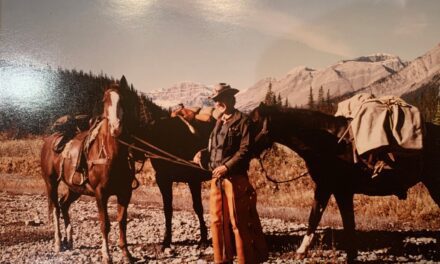
(1:08:58) What was the other part of the question? Oh cabins, well, there are so many different locations! (In response to the answer, “What was your favorite cabin or place?”) I spent a lot of time in Willow Creek in Jasper that was just the main hub for coming and going on the North Boundary. I’d say in Jasper there are quite a few more cabins, I mean the Fiddle River and Whitehorse Pass, was my initial district out of Pocahontas. There were two cabins there that were comfortable. Adolphus near Robson in the north end of the park, in Jasper again, another favorite location just because you are under Mount Robson and the Berg glacier. It was very impressive! And Blue Creek was one of the bigger district cabins. It’s like a three room cabin, especially when accommodating a Warden family, like in the historic backcountry district concept, before “centralizing” came along. On the South Boundary area, there was Jacques Lake, Rocky Forks, Isaac Creek & Brazeau, all unique & serving their purpose for patrolling, with a few smaller ones in between.
(1:09:55) You just spawned another issue I had. They were helicopter related, because in Jasper I was doing resource collecting research permits. Scientists would apply for a permit to come to the park, to look at some fossils or to look at some geologic formations that were exposed, versus what they were drilling for oil out on the prairies or do some archeological digging or whatever. So I would have to review the application and on occasion, I would be able to go out with them in the field to learn…or they would also come to the office and show us the specimens and we would sign them off and they would take them for instance to the Tyrell Museum, in Drumheller…They loved when you would show interest in their project. A lot of the park staff couldn’t care less. They would just say, “Oh yeah nice…” But I always showed interest and I was always invited to go and visit them there at Tyrell for instance. On this one occasion it was with an oil company, Shell Oil, was wanting to look at a location…where bedrock was exposed above ground as they were drilling in a formation further to the east, outside the national park… they drill through to see all the different layers…anyway, we ended up on Mount Kelsey, just above the Blue Creek Warden Cabin and we knew the weather was bad. I was with the geologists because you were landing a helicopter in a little more remote area …and they wanted a warden on board. So anyways we got grounded up there in a fast approaching hail and snowstorm. We were maybe 300 meters away (from the helicopter) when the pilot (Gary Foreman) called us to get back. But by the time we all got in and he got the rotor all wound up, we had to shut it down because freezing rain/snow iced up the rotor blade immediately. We had to sit there for a couple of hours and wait it out, until the storm passed through and then Gary used one of the geologists’ rock hammers to carefully chip off the ice on the blades. I remember that vividly! In fact, we looked at our map & were considering the bush whacking route down to the Blue Creek cabin, in case we had to overnight.
(1:12:14) But talking about helicopters too, I experienced a “near miss” situation way up in the Arctic, that I will never forget either! We were at Komakuk Beach which is a Distant Early Warning (DEW line) site that was active on the North Slope of the Beaufort Sea, Yukon Territory. We were with a contract survey crew and we were going to fly from there to the next one (DEW line site) called Stokes Point, to assess a remediation project. The chopper was fairly heavily loaded with our gear and fuel. We were staying in the DEW line site camp, I mean it was a work camp but it was more than just comfortable. It had a cook and the facilities were quite nice. But we had to sit out this snow storm, so our chopper sat out there on the tarmac for a couple of days and didn’t get covered with a tarp. What we call the scoop (Elephant ears), just below the rotor blade (filled with snow)…so the day it cleared up we loaded up our gear and the pilot had the machine (Bell 206) running to thaw and with water dripping and running all over the cowling as it was warming up and thawing out. The pilot and I were both outside the machine as it was idling trying to load things in and all of a sudden it just quit running, it shut off! We looked at each other through the bubble doors and said, “What just happened?” He started opening some engine covers and everything looked fine so he started it up again and took it for a little run by himself. He lifted up and there was snow falling off and it ran well. He came back and landed and we all loaded up in the machine. There were four passengers and the pilot, (the machine was) full of gear and fuel. We were about a minute and a half into the flight when again it cut out! The “auto-relight” for some reason malfunctioned because what had happened was… a chunk of snow had somehow lodged up in there in the air intake and it “snuffed” out the re-ignitor. So here we were in autorotation, heavily loaded in the tundra environment.This is the arctic, there are no trees, nothing up there and the pilots train for this, as you know…he found a little tarn, a frozen lake, to land on. But we were so heavy and he misjudged a bit so we slid forward a little bit into some muskeg tufts and turned up one of the struts (landing gear)… if you have the misfortune to land too heavily (G-force) and realize you’re sitting with your seatbelt on, there is potential for a fire. By the way, in a Bell 206, the fuel bladder is positioned under the rear three seats. And I quickly un-did my seat belt and just froze still there, it was eerily quiet. Wow! No tail boom chopped! We just felt so lucky that we didn’t have a worse situation. As we were within eyesight of the DEW line site, we easily walked over to the camp.
Usually the pilots we contracted up there had seven to ten thousand hours of experience and arctic flying was a necessity because it is similar to mountain flying terrain. You need to be experienced because conditions can change up there, with the whiteouts and everything else. And turbulence, oh man! We had some terrible occasions where we had down drafts, unbelievable! Like a thousand feet – You don’t want to be in there and you want to have your seat belt on because you are going to hit the cabin roof! Anyways, that was my bad experience and it took me a long time to get over it. But we had to get out of there and so did that pilot. The company flew a mechanic up and determined that there was nothing wrong, it was just an incident to do with the snow, the particle separator didn’t prevent the chunk from snuffing it out and something, for whatever reason, the auto-relight didn’t kick in…so the pilot flew it back to Inuvik alone. The company owner and pilot, Jim Hodges, came out in another machine and we flew in tandem back to Inuvik. That is the end of that story, but it took me a long time after that to get back into that machine and get over that one to two minute initial flight portion, but I’ve had a few incidents that could have quickly gone south, as the saying goes.