Park Warden Service Alumni Society of Alberta
Oral History Project Phase 15 – 2026
In Person Interview with Terry Willis
Date/time: March 18, 2026
Interviewed by Leah Pelletier
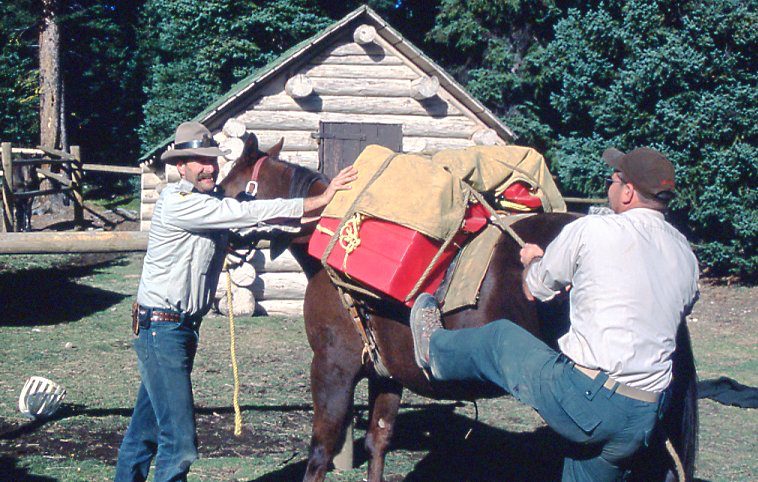
Park warden Hal Morrison, left, lends Terry a hand while he finishes off the diamond hitch.
Place and date of birth?
TW: Vancouver, B.C. in 1956
LP: Where did you grow up and where did you finish school?
TW: I grew up in Vancouver and attended high school in Vancouver. I went to British Columbia Institute of Technology (BCIT) for forestry and then fish and wildlife which gave me the diploma I needed to apply for the warden service. BCIT is just outside of Vancouver. It was the closest school that had natural resource technical diplomas – not a degree.
LP: From there, how did you become involved in the warden service and which national park did you start working in?
TW: I became involved with the park wardens the year after I graduated from BCIT. I got a job as a ski patroller in Jasper working at Marmot Basin. At that time the wardens did avalanche control in national parks, so they did avalanche control in Jasper, Lake Louise and Banff. Through being a ski patroller, I got to know some of the wardens and we’d go on some avalanche operations. We’d help them out doing some avalanche control, be spotters or stuff for them, so then I got sort of a sense of what a warden did. That winter there was a seasonal warden competition, so I prepared for the competition. I had the right education. I got some tips from the wardens and went for an interview that spring and got a seasonal position in Elk Island National Park, just out of Edmonton. That was in 1980.
I’m not sure how many people they interviewed, but I think they put maybe 20 on a list and they sort of went number one goes here, number two goes here. I think I was 10th on the list. I remember in the interview they asked me, ‘is there any place you wouldn’t go?’ And I always liked mountains, so I said, ‘OK, well I’m not going to go to Elk Island,’ and sure enough, ‘well, if you want a job, you have to go.
LP: What made you want to join the warden service?
TW: This sounds corny, but as a kid I used to watch Disney movies about park rangers and stuff like that, so even in high school I knew I needed to get the education to be a ranger or a warden or something like that – something working in the field. I couldn’t see myself being in an office type job. In the end, it did end up being largely an office type job, but that was 40 years later.
LP: What different parks did you work in?
TW: It was interesting, Elk Island was just a summer job, and I wanted to do something for the winter and I didn’t really want to go back to ski patrol. One of the wardens there said, ‘well, you should talk to this guy I know who works in Rogers Pass. He works with the National Research Council doing avalanche research and sometimes they take wardens to be their winter staff.’ His name was Paul Anhorn. I met him in Revelstoke, and he said, ‘oh yeah, well we got lots of people applying.’ Then I went home to Vancouver and it just turned out that the headquarters for that division of National Research Council was in Vancouver and so Peter Schaerer who was one of the grandfathers of avalanche control and avalanche safety, called me up and said, ‘you want to come in?’ It was like a 15-minute drive from my home to his office and after a very informal interview he said, ‘OK, you can have a job,’ so then I worked winters in Rogers Pass for three winters doing avalanche research and then in the summer I’d go back to Parks. Then after two years of that in Elk Island, I transferred to Jasper and I worked in Jasper for six years.
In Jasper I did largely public safety at what they called “Mile 45 or Sunwapta Warden Station”. Just a little north of the Columbia Icefields on the Icefields Parkway there was a warden station there. So, we lived there and we did avalanche control, avalanche forecasting, rescues, car accidents, backcountry patrols, law enforcement, everything. I stayed in Jasper until ‘88 when I went on another interview and got a full-time job and was transferred to Yoho National Park and the position there was primarily public safety but back then wardens were generalists; they did everything. We lived in Lake Louise for a couple years, then lived in Field for nine years and then took a break from parks. My wife and I moved to Victoria for a year, and I worked for the BC Government as the search and rescue specialist for the provincial emergency program. Then in 2000, I decided, – that was office, it was almost all office – since I’d taken a leave of absence, I could come back to my old job, so I did that.
LP: So, then you came back to Yoho National Park?
TW: Well, in 1997, Yoho, Lake Louise and Kootenay were amalgamated into one field unit, so then I worked out of the Lake Louise Warden Office. and lived in Lake Louise again. When I came back from Lake Louise, my public safety position was gone. Public safety became the realm of the mountain guides and I wasn’t a mountain guide, so I wasn’t qualified anymore, so I worked general duties (called Protection Operations, or ProOps) as the operations coordinator which was a supervisory position. After a few more years, I then worked in the fire program for three years running the operational fire program. It’s important to note that around 2000, the wardens were taken out of law enforcement because of the arming issue. There was a grievance put forth by a Banff warden (Doug Martin) saying wardens should be armed if they’re doing law enforcement, and it went through all the grievance procedures, and he won. So, the government said if you want wardens to do law enforcement, you have to arm them, and parks didn’t want to arm anyone with handguns. For two years they got the RCMP to do law enforcement and wardens were totally taken out of law enforcement. Then around 2008, parks got together and said, ‘OK, we want park wardens doing law enforcement again and so only designated park wardens were allowed to do law enforcement,’ and that was kind of the final straw with wardens being generalists. Ottawa wanted control over the law enforcement wardens and the law enforcement program so Parks Canada formed a Law Enforcement Branch (LEB) as a way to manage law enforcement, wardens and the handgun arming issue. They had a new warden competition and I applied and got a job in the LEB as the law enforcement supervisor for Banff. Beginning of 2009 the first troop went to Regina for RCMP depot training, and we all learned how to use firearms, arrest suspects, and defend ourselves. It was basically the same sort of certifications as the RCMP got but was crammed into six weeks. My last posting was 2009-2019 doing law enforcement in Banff. That was fun because I got to set up the program and we had six to eight warden staff, and we got to set up how we were going to do all our operational law enforcement duties. What was interesting about that is we didn’t work for the park, we worked for Ottawa. So, my boss was from Ottawa, we reported to Ottawa, but we also had to do what the park wanted. We were there for the park and Ottawa. It was very confusing at times but also very rewarding.
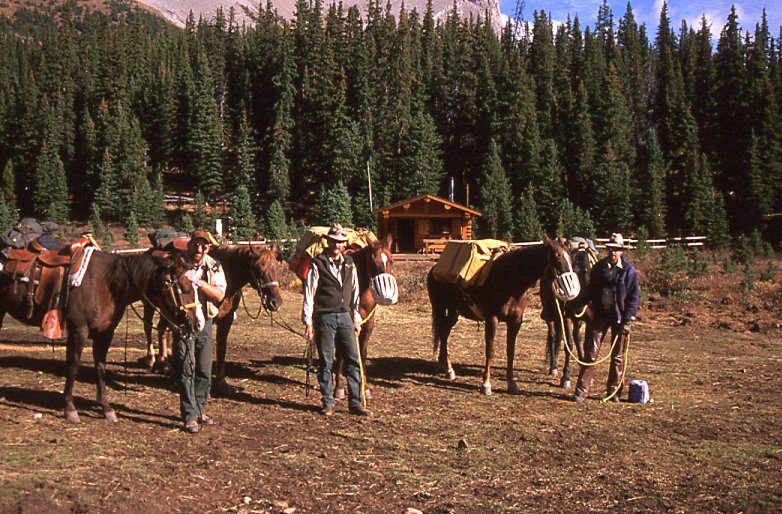
From right: Warden Ivan Phillips, Hal Morrison and Terry Willis in the backcountry of Banff National Park around 1990.
LP: Was that part of the transition between the new era vs. the old era?
TW: It was moving that way. When I started, we did everything, but when they made the field units like Lake Louie, Yoho, Kootenay, that’s when they started specializing more and more. If you were going to be public safety you had to be a mountain guide or if you wanted to work in the wildlife program, you had to have a wildlife degree or a biology degree. In the fire program, you had to have a degree.