Some of my best friends are people who I’ve worked with for all those years and often we talk about the good old years. However, part of the reason why it was the good old years is because you had some more control over your day-to-day work or your day-to-day tasks or even your goals for that year or that season or that project. That’s less now. If you’re more of an independent-minded person, sometimes it’s harder to live with that. Some people left. They couldn’t handle it. I considered myself lucky because I have the type of personality where I could focus on things that I enjoyed and I could filter out the negative, (like, the three days of scheduling in a row I had to do). It was like, ‘OK, well I can live with that because I know in three days, I’m going to get to go on a backcountry trip or a climbing school, or I get to do some other stuff I like.’ Whereas other people had a harder time separating that or living with the changes. I was fortunate because I felt I was able to just really focus and enjoy the things I liked and, I won’t say ignore but live with the things that we didn’t like or didn’t agree with.
One of the reasons why I was around so long is because even in law enforcement, I could do some of the things I like to do, help the people I worked with, still try to protect what I could of the park. It was still worth it. A lot of it was personality I believe.
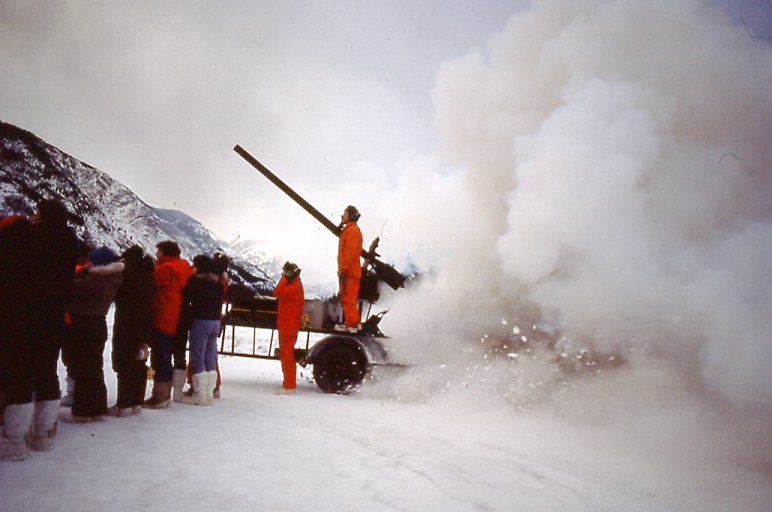
Avalanche control in the mid 1980s along the Icefields Parkway with the 105mm howitzer.
LP: What about the Warden Service was important to you?
TW: It’s kind of the corny old stuff like protecting animals and protecting the ecosystem. I’ve always being pretty empathetic to wildlife and to people, so it was kind of a natural fit to want to help people as well as want to preserve ecosystems and wildlife, and I always found wildlife really, really interesting. For a while, I kind of tried to carve out a career as a wildlife photographer, so I worked really closely with wildlife trying to get photos – that was more when I was seasonal, so I had winters off to work on stuff like that. Just being close and watching wildlife I always found it so interesting and so then naturally trying to protect them is a natural step to that. Then, just being able to help people – that’s kind of the EMS side, public safety side.
LP: Do you have any memorable mountain rescue stories?
TW: One of the ones that sticks out in my mind was in Yoho, there’s all these ice climbs (many accessible from a road or railway tracks) and I was really good friends with the guy who ran the BC ambulance in Field. His name is Graham Poole. I got a call from Graham one day saying, ‘We have these people who are staying over at our place and they’re ice climbing, but they haven’t come back and it’s getting dark. I think they might be overdue.’ So, started thinking about a response as it was after work hours. Then shortly after that, the CPR railway train crew found this guy on the railway tracks who’d been caught in an avalanche on one of these ice climbs, and they brought him into Field. He had broken his ankle during the avalanche and hadn’t been able to find his climbing partner (they didn’t have avalanche beacons with them). He ended up going to Banff with the Field ambulance, I think with Graham. So, now we (Yoho Wardens) start a nighttime search and avalanche rescue in Yoho while the Lake Louise wardens were just finishing their own rescue in Lake Louise. They came down to help us, and we all skidooed along the tracks to the access trail at the bottom of the ice climb that they were on. We followed their tracks up to the edge of the avalanche debris, — it definitely was an avalanche — did a quick search, no sign of the guy, called the dog handler from Rogers Pass because there was a Parks Canada avalanche search dog based in Golden. Then, we started a probe line, and it was the middle of the night. It’s dark with only your headlamps for light. You can’t really see very far as you’re probing up the debris field, and there is the ice climb at the bottom of the avalanche path directly above us. Even though there were only about seven or eight of us, we still had to post a look out to warn us of any additional avalanches. Sure enough, halfway through the probe line and rescue there was another avalanche that the spotter warned us about. We had to run and dive off the avalanche debris and into the deep snow and bush off to the side of the runout zone and wait for the avalanche to stop, and, luckily, the debris didn’t come down as far as we were, but it was pretty close.
Once the dust settled, we kept on probing. The dog handler’s name was Gord Peyto, and his dog was Barren and once they showed up, it only took five or 10 minutes for them to locate where the person was. We probed the spot, found him right away, dug him out – he had been buried for several hours by then and was unfortunately dead. We evacuated him back down to the railway tracks and then tobogganed him out to Field. That was one that I always remembered because we had the search dog team, the other rescue, we had the other guys from Lake Louise involved (and) the medics from Field. Though not a great outcome – one guy was OK, one guy wasn’t. There’s lots of stories like that, but that was one I just remembered because I lived in Field at the time and I knew Graham as a friend and colleague and knew the climber was a friend of his, so it’s also that sad personal part of the story, too.
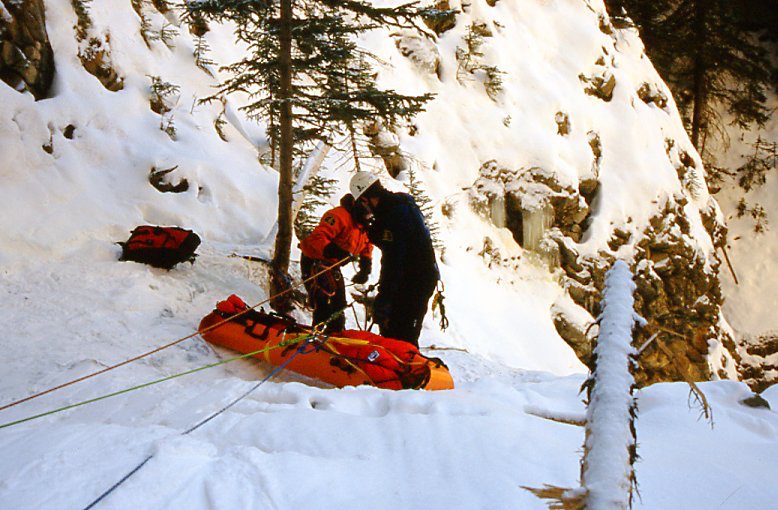
Winter rescue training.
LP: Are there any legends or stories associated with the Warden Service that you can share? Is there anyone from the Service that stands out in your mind?
TW: Well, I worked with a lot of people who, in a way, could be legends. One of those historical people is Gord Peyto. He’s related to Bill Peyto, and he was a park warden and dog handler who lived in Golden and worked out of Rogers Pass. He was a bit of a crusty old guy and was one of the first dog handlers out there and sort of instrumental in keeping the dog program going. When I worked at Roger’s Pass, we’d sometimes go skiing with him and it was interesting because when you started to go skiing downhill, his dog would attack your ski poles as you’re trying to ski which is always kind of disturbing, but in my view, he was one of the legendary wardens of the ‘70s, ‘80s, for sure. I worked a little bit with Alfie Burstrom, who was the first dog handler in Jasper, and his dog, Ginger. I think they were one of the first avalanche dogs in Canada and was well known for his avalanche rescues. I’ve always had a soft spot for the dog handler program. When I worked in the law branch in Banff, we had the only dog handler, Mike Henderson, he’s not a legend now, but he probably will be in a few years and he’s one of my best friends, so people like that are legends to me.
The interesting thing, when I started, we had at least five dog handlers in Parks Canada — one in Jasper, one in Lake Louise, one in Banff, one in Roger’s Pass and one in Eastern Canada. Now, we have one dog handler, so that’s where you’re talking about changes and that’s, to me, a real unfortunate change. We should have way more than five dog handlers now, but it’s kind of political, and they cost money. Either in response to not having dog handlers or maybe because now parks supports the use volunteer dog handlers; but now there’s Canadian Avalanche Rescue Dog Association (CARDA), so that hole is being filled by volunteers and provincial search rescue groups for the avalanche side of search and rescue. But there’s still the whole law enforcement side and searching side that I think parks is missing out on.
My main mentors were people like Brian Wallace, (my supervisor at Mile 45) who ended up being the chief warden in Jasper, and Rod Wallace who taught me about horses and helped me not get killed by horses. So, people like that, I’d call them, in my mind, legends.

Boundary patrol with Mike Henderson and police dog Cazz around 2017.
LP: Is there anything about the Warden Service as you knew it that you would want future generations of Wardens to know?
TW: I guess we’re talking law enforcement wardens. Those are the only wardens that are left. I guess I would want them to know that they’re from a pretty significant historical group. Their history is they used to do everything, and they were the first ones out there and back well before my time they were the only ones out there. They would live in the warden cabins and the warden stations. Just for them to know that there’s a history that goes beyond their sole focus of law enforcement, and that if they could keep that in perspective when they’re dealing with the visitor safety guys, the wildlife conflict biologists and the fire veg folks that they used to be part of one big family and even though they’re not part of the family now, they should still think of them as cousins or relatives because all those groups are what makes Parks Canada work and able to do what it’s supposed to do, which is protect and leave the environment and parks for future generations. I think that would be the important thing is just to know that even though you’ve got your law enforcement focus and Parks Canada might be just hiring police type staff now with very little resource background, for those folks to know that they used to be part of a bigger service, and they really try hard to work with all those groups and understand where they’re coming from.
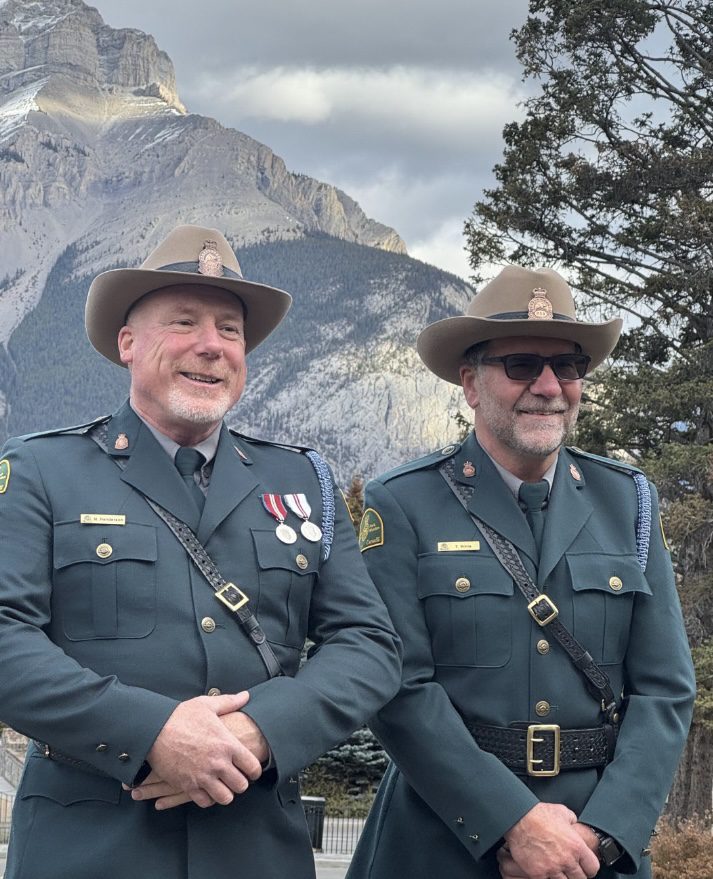
Mike Henderson, left, and Terry Willis in ceremonial tunics during the LEB Exemplary Service Awards in 2025.
LP: What made the Warden Service such a unique organization?
TW: At first, I thought that the way I would answer that is that it’s not a unique organization. There’s lots of organizations that are out there like provincial rangers, U.S. rangers, there’s a lot of groups that their main goal is resource protection and education which is, simply put, what parks does. There’s a lot of agencies out there that do that, so in that way I thought, well, we’re not really that unique. But I think we are unique in that it started so long ago when so few countries had national parks. Parks Canada was one of the pioneers and started the park warden job. In that way, it was one of the first ones. U.S. parks and some of the other countries did that but not many were doing that 100 or so years ago. I think what might be called unique is the way we have now specialized, like provincial parks hasn’t quite gone there. A lot of their rangers do many, many different things, not just law enforcement, so maybe jumping into the specialization so deeply is unique.