Four or five years later, we ended up all in court because they were pleading not guilty to some of the charges. We had a big trial and he got off on most of the charges because they couldn’t be proven but was found guilty on some charges. It was from one event that went on for hours and then it went on for years with the trial because we (park wardens) had all the evidence, not the police. We were questioned on, ‘well how did we search the vehicle? What did we find? You know, was it admissible in court?’ And most of it was, so they got charged. However, there were just too many gaps in all the evidence to prove everything. Interesting to note that they had been in jail for years already, so my guy had served most of his time already. That was a sort of interesting one in the new world where we could use all our enforcement training and all our enforcement equipment. We still had to work with other agencies to get the job done and it all worked out OK, no one got hurt.
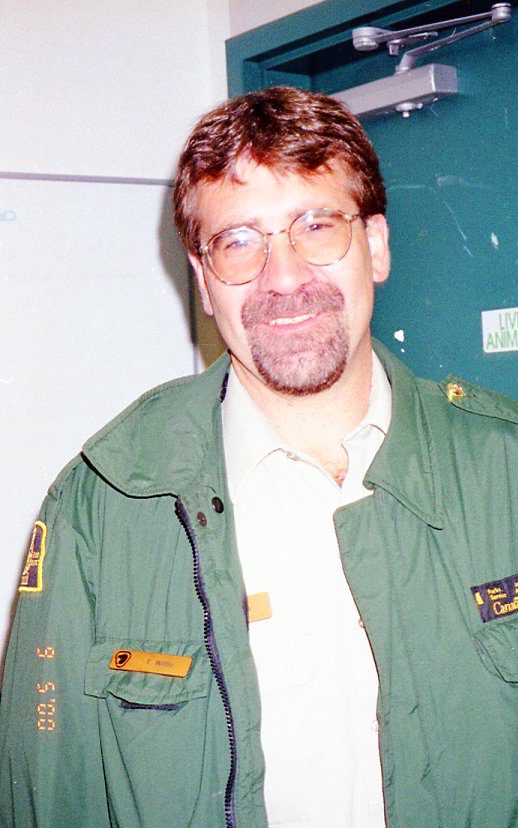
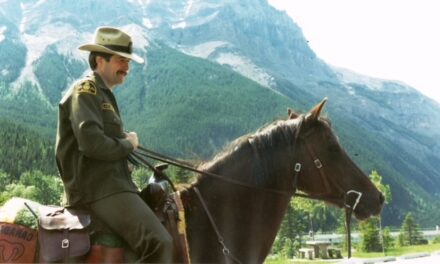
Terry Willis as a park warden in Yoho National Park around 1990.
LP: I understand you worked as a paramedic for a few years. Did that ever coincide with your role as a park warden?
TW: When I was in public safety, I was always very interested in the first aid, medical side of things. When I ended up not being in public safety anymore, I really wanted to do that. I went back to school and became what was called an emergency medical technician (EMT), and I worked for Banff EMS and was employed by Mineral Springs Hospital. After that I went to Victoria for that year and I became even more interested in EMS. When I came back, I was granted educational leave from parks and for two years I went to school at SAIT to be a paramedic. At that time, SAIT had an outreach program, so most of your studying on your own and you would go into Calgary maybe six times a month for two or three days at a time for hands-on skills training and then you also had a lot of practicums working under a full-time paramedic or nurse, which I did mostly in Banff. When I got my license as a paramedic, I would mainly work part-time in winter – maybe eight days a month with Banff EMS on the high-volume third car, like when it was really busy during the day.
Parks, they could have had the option of incorporating some of those skill sets into the public safety program, but at that time they were not able to move in that direction, so I just did part-time paramedic work with Banff EMS. But ironically, that story about when we arrested those guys, I was in the back of the ambulance with all the paramedics I normally worked with, so it was an interesting experience for all of us. And when we arrived at the hospital, the ER docs, they’re all going, ‘oh, I didn’t realize you wore green and had a gun, too.’ And the nurses would always tease me about it. They’d say,‘are you here wearing your gun today or are you here wearing your stethoscope?’
LP: So, how many years did you work as a paramedic?
TW: 18 years. Once COVID-19 hit, everything was locked down and there was no one coming to Banff, so there were no calls and no shifts available. Where you used to do 20 calls in a tour of four days, now there was maybe one or none, and for months I didn’t work any medic shifts, and so then I was starting to get rusty. I’d just retired from parks, and it was like maybe it’s time. For the amount you gotta keep on top of things for a few days of work here and there, it just was not worth it. I resigned from the hospital and just let my paramedic license expire.
LP: Can you tell me about any rescue/wildlife stories that stick out in your memory?
TW: There’s one big incident that lot of people know about and the alumni might know of it, too? It’s kind of a public safety, wildlife, front country story and it’s going to take a while to tell but it’s so interesting. Anyways, it was mid 1990s, we were living in Lake Louise, and I was on standby. So standby would be, you’d take a truck home, take your radio home or pager home and dispatch would call you if something happened. I got called about five in the morning for a vague report of something happening on the Field Hill (TCH in Yoho, West of West Louise (Wapta Lake) Lodge). It was winter and bad weather and dispatch said, ‘we don’t know what’s going on, but there’s a call that there’s something happening on the Field Hill.’ So, I go down there and it’s a big snowstorm, and in the middle of the road there’s this four horse trailer and a big pickup truck stopped there, it’s got its flashers on. So, I go over and there’s this old woman sitting in the passenger seat and right away you could tell she’s like a rancher or farmer, and I said, ‘what’s going on?’ And she says, ‘my husband’s stuck in the back of the four-horse trailer with our bull.’ There’s a 2,000-pound bull in the back of this four-horse trailer, and what’s happened is it was really windy, and the rancher could hear the bull moving around in the trailer. He stopped and went to check on the bull. This four-horse trailer had a divider in the middle with the bull in the back half, and then the front part was the hay and other stuff.
The rancher saw that the bull was restless, so he decided to throw some hay in the back for the bull and he just cracked the divider open to throw the hay in when a wind gust hit the trailer and the bull panicked and crashed through the divider. The rancher tried to dive out the side door but the wind slammed the door on him, and then he was stuck inside this horse trailer with a 2,000-pound bull that was really mad. The bull headbutted the old rancher and threw him against the ceiling and then started stepping on him. Now he’s severely injured (the rancher), on the floor of the four-horse trailer, the bull is really mad and there’s no way to get to him. Once I figured out what was happening, I got dispatch to call back up (wildlife and operational wardens and EMS) because we’re going to need help here. One of the interesting things was that the portable radios we talk on really bothered the bull, the bull hated the radios and so whenever it would hear a radio, it got excited and would start stepping on this guy. It turned out we had to whisper to dispatch on the radio to give them details and you had to crawl along the road so you could talk to the rancher on the floor of the horse trailer without the bull hearing you and getting mad.
We were reluctant just to let the bull out in the middle of the highway, so the first group of wardens and paramedics came from Field, the second group came from Lake Louise and Banff. We decided the only way we could manage this was to close and block off the highway and then open the horse trailer. We blocked off the highway down by Field and also close to Lake Louise at the Great Divide. Once we opened the door and the bull ran out and then the medics got in and attended this guy, before transporting him to the hospital in Banff. Since I also worked for Banff EMS, I jumped in with them and turned the operation over to the warden in charge of human wildlife conflict, Hal Morrison. He took over dealing with the bull because now we have the bull in the middle of the Trans-Canada Highway. They tried to get the bull back in the horse trailer, but it didn’t want to go back. They tried to corral it with trucks, but it would hop around the trucks. They got snowplows with their big snow blades to try and get it back into the horse trailer, but it wouldn’t go in and then it started running up the highway towards Lake Louise. The bull went all the way up the highway past West Louise Lodge and Wapta Lake and it was coming towards where all the traffic was stopped in the roadblock and the wardens were waiting. The bull got closer, closer, closer and then finally we had no choice. So, they shot it with a shotgun slug right between the eyes, and it didn’t even knock it down. Then they shot it with a high-powered hunting rifle right in front of the roadblock and that finally killed it. There was no choice. They couldn’t have it amongst the public. The dispatchers all remember that story. It was an exciting and interesting event. Afterwards, I could imagine the public were driving by and wondering why there’s a 2,000-pound bull lying off of the side of the highway. They needed to get a park crane truck to get it off the road.
The poor old farmer, ended up being med-evac’d to Calgary. He had punctured lung, broken ribs, broken bones, but he survived. The other interesting thing, too, is that all this happened to be when the hospital was building new ambulance bays, so the ambulances had to park right out front of the hospital where the public entered. We had to park and leave the ambulance there as everyone was busy rushing this guy into the ER, and it turned out everyone had just abandoned the ambulance there, so the funny part was people were going in for their appointments and there’s an ambulance sitting there, the back doors are wide open, there’s hay and blood and bandages all over the inside of the ambulance, and everyone’s like, ‘what is going on, what happened here?’ Finally, one of the medics came out and cleaned it all up, but for 20 minutes we were all trying to save this guy’s life – no one was worrying about the ambulance.
LP: How did the Warden service change over the years?
TW: I guess I would never think of myself as an old timer, but really, I am now. You look at all the young people now in it and it’s pretty unrecognizable. When I started, you literally did everything. You could be in the campground one day and then you could be doing a rescue on the next day, and then you could be on a week-long horse trip looking for poachers or whatever and then you could be on chasing bears or working on a wildfire. Now, all those things are still done, but the warden job of the past is specialized. Only Park wardens do law enforcement, at least in the mountain parks. Public safety rescues, avalanche control, avalanche safety are only done by mountain guides, and maybe it’s a little different with fire management or in smaller parks up North or back East. Most jobs now require an educational degree, usually it’s pretty specialized, at least the managers are pretty specialized. The guys who used to chase bears, like human- wildlife conflict, I think now you have to be a biologist, at least in Banff, you have to have a degree in biology and a lot of them now have masters. They might help out in some areas, but it’s just all so specialized. Parks still does all the core stuff, it’s just all specialized. In some ways, the service might be better. We’re probably better at law enforcement than we were 20 years ago, but my view is we’re not as efficient as an organization. Because 90 per cent of the rescues that we’re doing could be done by someone who knows how to ride a horse or knows how to trap a bear. So, one guy could do all those things but now it takes many different people to do all those things. I think that’s just the culture we’re in and the environment we’re in as a civilization. Everything is getting more and more specialized.
I think the other thing that’s happened that we didn’t talk about, but it’s changed, is I think Ottawa has way more control over what happens in the field than they used to. Back when I started, Ottawa (national office) was not very big and not many people. Now Ottawa, at least in parks, is probably hundreds of people. In my experience, national offices now pretty well dictate what happens, definitely at a policy and management level in the parks. When I started, the individual parks were much more autonomous. They did what they wanted or did what they felt they needed to do, so that was definitely a change, I think. When I started the person in charge, who got total say over the park, was the park superintendent. Now the park superintendent answers to a regional manager who answers to a director who answers to a PM and so they don’t nearly have as much control or say as they used to. The chain of command is tighter and thicker.